
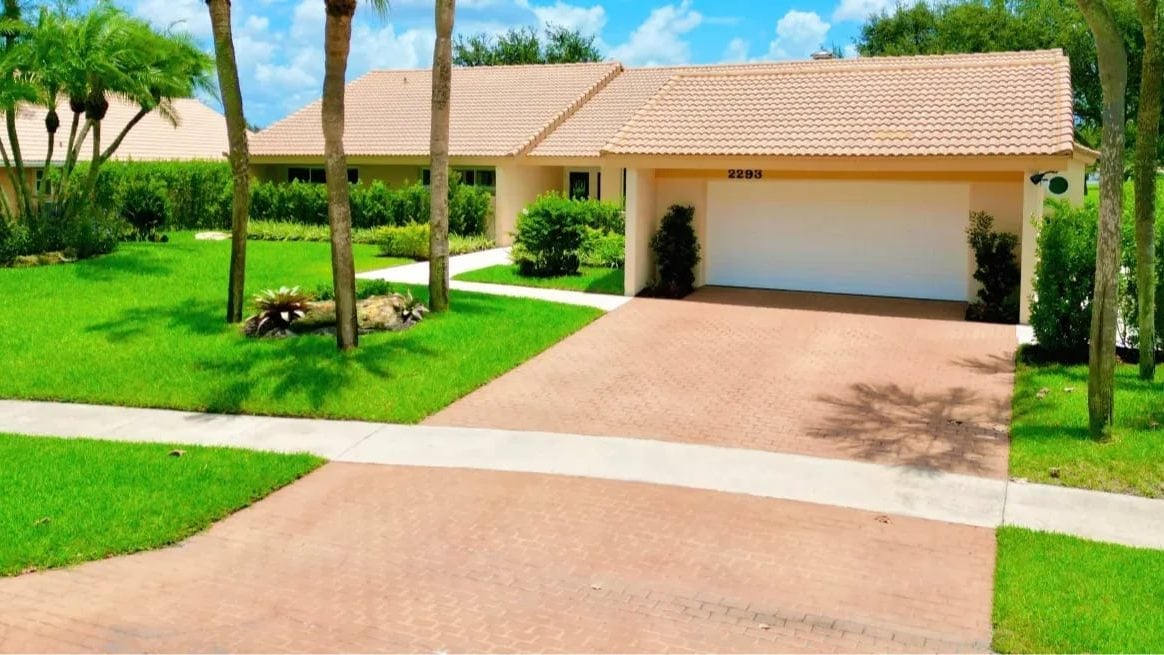
Most driveway comparisons are written for the whole country, which makes them close to useless here. The factors that decide this in Fort Lauderdale are not the ones that decide it in Ohio: our ground moves, our air carries salt, our sun is relentless on a light-colored surface, and our rain arrives faster than a flat slab can shed it. Get the material right for those four things and the driveway lasts decades. Get it wrong and you are looking at a cracked slab in year six.
Here is how pavers and poured concrete actually behave on a South Florida lot, what separates them on cost and install time, and the situations where each one is the right answer.
The short version
Pavers win on movement, repairability and looks. Concrete wins on upfront cost and on simplicity. The thing that decides whether either one performs is the same for both: the base underneath it.
That last point gets lost in most of these comparisons. A paver driveway on a poorly compacted base will settle and open at the joints. A concrete slab on the same base will crack. The material choice changes what failure looks like, not whether failure happens.
How each one behaves in South Florida specifically
Ground movement
This is the clearest difference between the two, and it is the one that matters most locally. A concrete driveway is a single rigid plane, so when the ground underneath shifts, the slab has to relieve that stress somewhere. It does so by cracking. Expansion joints and proper drainage control where that happens and reduce how bad it gets, but the mechanism does not go away.
A paver driveway is not one plane. It is hundreds of individual units on a flexible sand-set bed. When the ground moves, the field flexes with it. Individual pavers will not crack the way a concrete slab does, which is the single strongest argument for pavers on a lot with any history of settlement.
Repairs, which is where the money shows up later
A damaged paver can be lifted and replaced without disturbing the surrounding surface. You pull the affected units, fix whatever is underneath, and relay them. Done well, the repair is invisible.
A cracked concrete slab has no equivalent. You can fill a crack, but you cannot make it disappear, and a section replacement leaves a visible seam and a color mismatch that only partly fades. On a driveway, which is the most visible hardscape on the property, that distinction is worth real money at resale.
Heat
Both materials have an answer here. Lighter-colored pavers reflect heat and create a cooler surface, and concrete can be specified with heat-reducing compounds and UV-resistant additives. If you walk barefoot from the car to the door, raise this during design rather than after.
Drainage and standing water
On a flat lot close to sea level, where the water goes is a code question as much as a comfort one. Both materials offer permeable versions: permeable pavers reduce runoff and puddling, and permeable concrete exists too. The paver route tends to be more flexible here because the joints themselves can carry water, but either can be engineered to work. What cannot be fixed later is grade, so settle it before anything is poured or laid.
Salt air
Both can be specified for coastal exposure. Salt-resistant paver selections and salt-resistant concrete formulations are both available. The real question is not which material category survives salt better, it is whether the specific product in your quote was chosen for a coastal site. If you are east of Federal Highway or anywhere near the Intracoastal, get that specification in writing.
Side by side
| Paver driveway | Concrete driveway | |
|---|---|---|
| Behavior under ground movement | Flexes; individual pavers will not crack like a slab | Rigid plane; relieves stress by cracking |
| Repairability | Lift and replace affected units, no visible seam | Crack filling or section replacement, visible seam |
| Install window | 5 to 7 days depending on size and complexity | 7 to 10 days start to finish, including curing |
| Usable when finished | Immediately: no curing time needed before use | After the curing period |
| Published lifespan | Maintains appearance for decades with minimal maintenance | 25+ years |
| Maintenance | Occasional pressure washing; reseal every 2 to 3 years | Minimal upkeep; sealing as part of the install |
| Design range | Travertine, porcelain, natural stone, brick, interlocking concrete pavers; herringbone, basketweave, running bond, circular, custom geometric; borders, inlays, medallions | Stamped patterns, exposed aggregate, colored finishes |
| Permeable option | Yes, joints carry water | Yes, permeable concrete |
| Coastal specification | Salt-resistant paver selections | Salt-resistant concrete formulations |
| Upfront cost | Higher | Lower |
Cost
Pavers cost more upfront than poured concrete for the same area, and the gap widens as you move up the material ladder from interlocking concrete pavers to travertine, porcelain or natural stone. The base preparation is broadly similar for both, so most of the difference sits in the paving material and in the labor to lay it piece by piece rather than pour it.
| Option | Relative upfront cost | What drives it |
|---|---|---|
| Poured concrete, standard finish | Baseline | Slab thickness, joint layout, site access |
| Concrete with decorative finish | +15 to 30% | Stamping, color, exposed aggregate |
| Interlocking concrete pavers | +40 to 70% | Material cost plus piece-by-piece labor |
| Travertine or porcelain pavers | +80 to 150% | Premium material, tighter tolerances, more cutting |
| Natural stone pavers | +100% and up | Stone selection, thickness, pattern complexity |
| Removing an existing concrete slab first | Added | Demolition, haul-off, then full base preparation |
These ranges reflect real project costs in the Fort Lauderdale and Broward County market in 2026. Prices vary based on the specific factors we cover below.
Be careful with a quote that comes in well under the others. The usual omissions on a driveway are the base work and the edge restraints, which are exactly the parts you cannot see once the job is finished and exactly the parts that decide whether it holds up. A conversion from concrete to pavers also means removing the old slab and preparing a proper base underneath, not laying pavers over what is already there.
Installation and disruption
Most paver driveway installations are completed within five to seven days depending on size and complexity. Concrete driveway installations run seven to ten days from start to finish, including curing time.
The number that affects your week is not the install window though, it is when you can park on it. Pavers need no curing time before use, so the driveway is usable as soon as the field is laid and the joints are set. Concrete needs its curing period first. If you have two cars and no street parking, that difference is worth more than it looks on paper.
Driveway work also tends to arrive bundled with other hardscape. If a paver patio or walkway is in the plan too, doing them together means one mobilization, one base crew and one set of material deliveries. Across a larger scope, most hardscape builds run four to twelve weeks from groundbreaking to walkthrough, a window that excludes design and permitting.
Maintenance over the years
Neither is maintenance-free, and the routines are different in kind rather than in amount.
Pavers want occasional pressure washing and resealing every two to three years. Joint sand needs topping up over time, particularly along edges and anywhere water runs. The upside is that every one of those tasks is reversible and incremental.
Concrete asks for less attention day to day and is described as requiring minimal upkeep compared with other materials, with sealing handled as part of the installation and periodic resealing after that. The catch is that when concrete does need attention, it is usually a crack, and cracks are not an incremental fix.
One more thing worth knowing: weeds in paver joints are a sign of maintenance, not of a design flaw. Properly compacted joint sand with a stabilizer, plus sealing on schedule, keeps it from becoming a recurring chore.
Which one fits your property
Choose pavers if your lot has any history of settlement, you want the driveway to be a design element rather than a surface, you care about being able to repair it invisibly later, or you are on a coastal property where you want a specified salt-resistant selection and the ability to swap damaged units.
Choose concrete if upfront budget is the deciding constraint, the lot is stable, and you want a clean monolithic look. A decorative finish gets you some of the visual range of pavers at a fraction of the step up in cost.
Either works if the base is built correctly and the grade sheds water. Spend your attention there before you spend it on the material.
Frequently asked questions
Are pavers or concrete better for a South Florida driveway?
Pavers handle our conditions better in two specific ways: individual pavers will not crack like a concrete slab when the ground underneath moves, and a damaged paver can be replaced without disturbing the rest of the surface. Concrete is the better value when the budget is the deciding factor and the lot is stable. Neither is universally correct, which is why the base preparation matters more than the material you pick.
How much more does a paver driveway cost than concrete?
Expect a paver driveway to run meaningfully more than poured concrete for the same area, with the gap widening as you move from interlocking concrete pavers up to travertine, porcelain or natural stone. The base preparation is similar for both, so most of the difference sits in the paving material itself and the labor to lay it piece by piece.
How long does a driveway installation take?
Most paver installations are completed within five to seven days depending on size and complexity. Concrete installations take seven to ten days from start to finish, including curing time. The practical difference is that pavers can be driven on as soon as they are laid, while concrete needs its curing period before the driveway is usable.
Do paver driveways sink or shift in Florida?
They can, and when they do it is almost always the base rather than the pavers. A properly built driveway needs correct grading, a compacted base and precise edge restraints. Without the edge restraint the field creeps outward over time and the joints open. The repair is straightforward compared with concrete: lift the affected area, correct the base and relay the same pavers.
Which driveway material handles salt air better?
Both can be specified for coastal exposure. Salt-resistant paver selections and salt-resistant concrete formulations are both available, so the question is less about the material category and more about whether the specific product was chosen for a coastal site. If your property is near the Intracoastal or the beach, ask for that specification in writing rather than assuming it.
See It on Your Driveway Before You Commit
Material choice is easier to make when you can see it at full scale on your own frontage rather than on a two-inch sample. We walk the property, check grade and drainage, and produce a photorealistic render of the driveway on your actual house, so the pattern, the border and the color are decisions you make before anything is ordered.
With 40+ years across Broward County, an in-house crew rather than subcontractors, and a lifetime workmanship guarantee on the build, we deliver initial designs within seven days. We serve Fort Lauderdale, Dania Beach, Davie, Deerfield Beach, Pembroke Pines, Coral Springs, Pompano Beach, Sunrise and Weston.
Every property is different, and the only way to know which material suits yours is a site consultation. Call (561) 269-4959 or email admin@totalscapedesign.com.
Cost relationships shown here are market comparisons for the Fort Lauderdale and Broward County area in 2026, not a TotalScape Design price list. Install windows are TotalScape Design’s published project timelines and exclude design and permitting. Material performance depends on base preparation, grade and product selection for your specific site; see our guide to driveway installation for more on the process.