
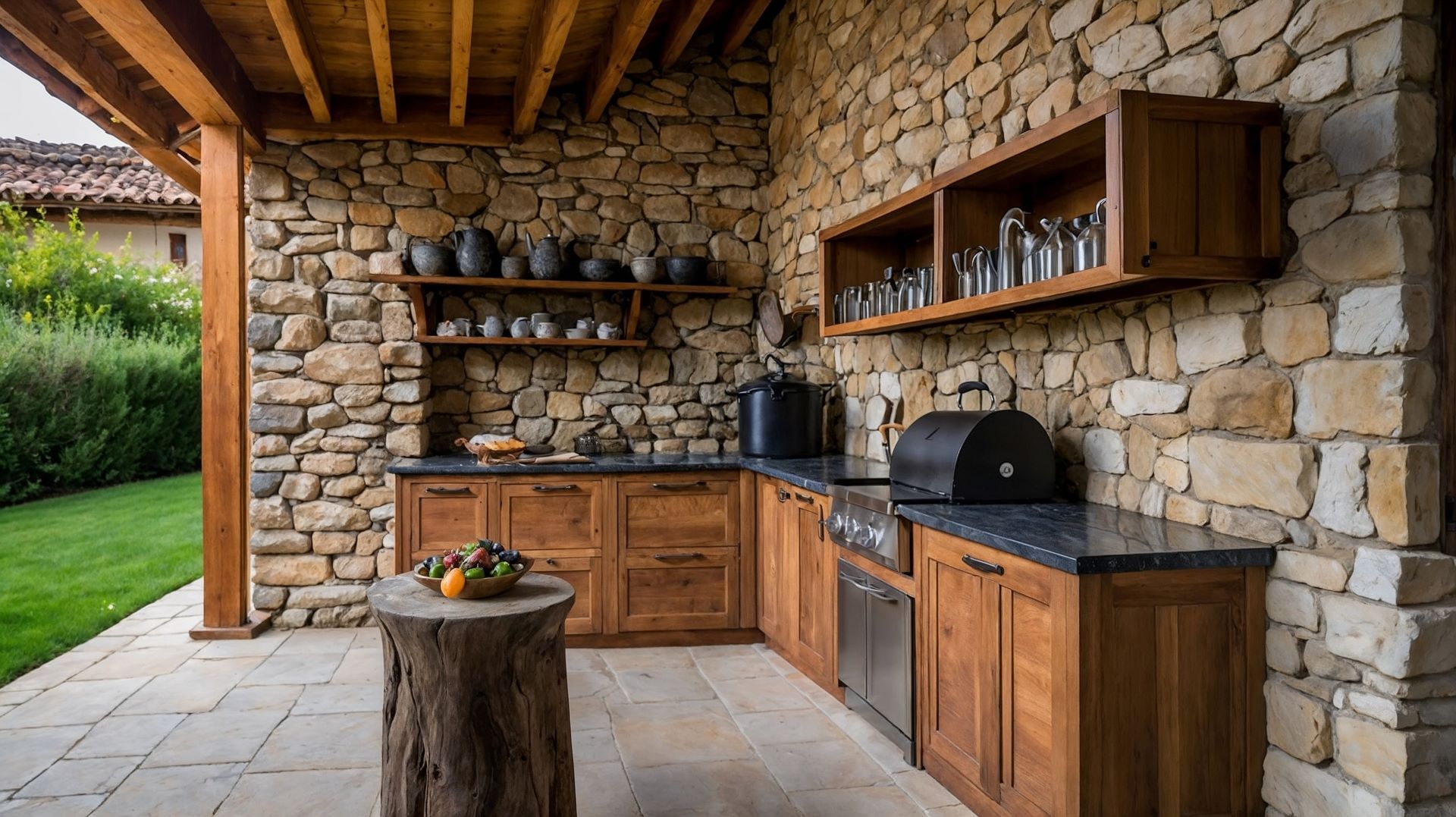
Most outdoor kitchens in Broward County are not undone by storms. They are undone by an ordinary Tuesday in August: eleven hours of sun on a countertop, air that never dries out, and a cabinet door that was never meant to live outside. The design decisions that determine whether an island still looks new in its fifth season are made weeks before anything is built, when somebody chooses the countertop, the cabinet boxes and the finishes.
This guide covers those choices for a South Florida property: what heat, humidity and ultraviolet light actually do to each common material, which products carry warranties that exclude outdoor use entirely, and where it pays to spend. Wind, anchoring and storm drainage are a separate subject, and we cover those in our guide to building a hurricane-proof outdoor kitchen in Fort Lauderdale.
These material recommendations reflect real project conditions in the Fort Lauderdale and Broward County market in 2026. Performance varies based on the specific factors we cover below. Every property is different, and the only way to get an accurate material specification for your site is a site consultation.
What the climate here actually does to a kitchen
The National Weather Service office in Miami publishes daily normals for the Fort Lauderdale airport station based on the 1991 to 2020 period. From June through September, normal daily highs run 89 to 91 degrees and normal overnight lows sit at 77 to 78. Even in January, the normal high is 75 to 76. There is no season in which an outdoor kitchen here gets a rest.
Three forces do the damage, and they do it differently.
Ultraviolet light breaks down polymers. Anything held together by resin, glue or pigment is on a clock from the day it is installed, and this is the force homeowners underestimate, because the first two years look fine.
Humidity works on anything that can absorb water. A substrate that takes on moisture swells and then shrinks, and after enough cycles the joints open and the cladding loses its grip. Persistent damp also gives mold somewhere to live, which is the complaint we hear most often about kitchens built with the wrong cabinet boxes.
Heat expands and contracts everything, and it concentrates around a grill. The surface temperature of a dark slab in full afternoon sun is a usability issue on its own. TotalScape’s outdoor kitchen page puts it plainly: South Florida’s humidity and intense sunlight require materials that resist corrosion and fading.
Salt is a fourth force on coastal and barrier-island properties and deserves its own treatment. For this guide, the short version is that any metal within sight of the Intracoastal or the ocean should be specified as marine grade.
Countertops: the decision that goes wrong most often
Engineered quartz is the trap
Engineered quartz is the most popular indoor countertop material in the country, so it is the first thing many homeowners picture for an island. It is also the one material on this list whose manufacturers have written outdoor installation out of their warranties.
Cambria excludes product installed outdoors, whether in partially covered or otherwise sheltered areas or not. Caesarstone states that its warranty does not cover products installed in any outdoor application. Silestone limits coverage to surfaces installed inside a dwelling and excludes exposure of the product on the exterior of buildings. MSI applies the same rule to its quartz line.
Read the Cambria language again, because it is the part people miss: a roof over the island does not help. The exclusions cover partially covered and sheltered installations, because indirect and reflected ultraviolet light still reaches the slab, and the resin binder that holds engineered quartz together is what degrades. The visible result is yellowing, and it does not reverse. The conclusion is not that quartz always fails outdoors. It is that if it discolors you have no recourse, and you were told so in writing before you bought it.
If you want the look of engineered stone outdoors, ask about sintered stone instead. Cosentino’s Dekton, for example, writes outdoor exposure into its coverage rather than out of it, warranting against fading due to direct exposure to ultraviolet radiation both inside and outside buildings. It is a different product from quartz, made a different way, and the warranty reflects that.
Granite, the straightforward answer
Granite is what TotalScape names first for outdoor counters, describing it as a top choice for outdoor kitchen countertops due to its durability and resistance to elements. It earns that: colorfast in sun, tolerant of a hot pan, able to survive the impact a crowded island produces, and available in enough colors to suit most designs. Its one requirement is sealing, because granite is porous and an unsealed slab will stain from oil, wine and marinade. That is a maintenance commitment rather than a flaw, and a small one.
Porcelain and sintered slab, the low-maintenance answer
Large-format porcelain and sintered surfaces are manufactured to be non-porous and colorfast. They need no sealing at all, they do not stain, and the better products are made specifically for exterior use. The trade-off is that they are typically thinner than a stone slab, so they need a properly built substrate underneath and careful handling at the edges. Where low maintenance is the priority, this is the category to look at.
Marble, travertine and limestone
These are beautiful and they are soft. All three are calcium-based, which means acid etches them: lemon juice, wine, vinegar and many ordinary cleaners leave a dull mark that is not a stain but a change in the surface itself. Honed finishes hide etching far better than polished ones, which is why a honed travertine counter can work on an island while a polished marble one tends to disappoint.
Where these materials excel is underfoot and on vertical cladding rather than on the working surface. TotalScape lists limestone as a lighter color that reflects the sun’s heat, keeping the area cooler, which is exactly the right use for it.
| Countertop material | Sun and UV | Sealing | Watch out for |
|---|---|---|---|
| Granite | Colorfast | Periodic | Staining if sealing lapses |
| Porcelain or sintered slab | Colorfast, made for exterior use | None | Needs a well-built substrate; edge handling |
| Engineered quartz | Resin binder degrades; yellowing | None | Outdoor use excluded from major warranties, covered patios included |
| Travertine and limestone | Colorfast; light tones stay cooler | Periodic | Acid etching; better as flooring or cladding |
| Marble | Colorfast | Periodic | Etches readily; polished finishes show every mark |
| Concrete | Colorfast | Regular | Hairline cracking is normal; wants a sealer that suits the mix |
Cabinets and the box underneath
The cabinet carcass is the part nobody photographs and the part that fails first. Two materials belong outdoors in this climate, and TotalScape recommends both in its own guidance on storm-ready kitchens: stainless steel, and marine-grade polymer or HDPE.
Marine-grade polymer and HDPE do not absorb water, swell, rot or give mold anything to feed on, and they are through-colored, so a scratch does not reveal a different material underneath. Where the air is damp around the clock, that is a real advantage over anything with a core.
Stainless steel gives you the professional look and takes heat well next to a grill. The grade matters, and on a coastal property it matters a great deal: TotalScape’s published specification for appliances is marine-grade stainless steel, and their hardscape work uses stainless fasteners and marine-grade hardware for the same reason.
A masonry island clad in stone or paver is the third route, and in South Florida it is often the best one. Built on a reinforced substrate, it is dimensionally stable, immune to humidity in a way no cabinet box is, and it lets the island match the surrounding hardscaping and paver work exactly. Doors and drawers then become stainless inserts in a masonry shell: the masonry carries the structure and the metal handles the moving parts.
What does not belong outdoors is any cabinet built on a wood or MDF core, however it is finished. Marine plywood with a properly sealed edge can work in a protected position in the right hands, but a standard kitchen cabinet moved outside will not last here, and the failure arrives as swollen doors and a smell rather than as anything dramatic.
Appliances, hardware and the parts you touch
Appliances are the easy part to specify and the easy part to get wrong. The published standard for our outdoor kitchen appliance and island packages is professional-grade stainless steel appliances, countertops and modular island systems, with marine-grade stainless steel for the appliances themselves.
Hardware is where corners get cut. Hinges, drawer slides, fasteners and brackets are small line items, and a kitchen fitted out with indoor-rated hardware will have seized drawers long before the counter shows any wear. Specify stainless throughout and marine-grade hardware near the water, the same standard applied to structural hardscape fixings.
Refrigeration deserves its own note. An outdoor-rated refrigerator or refrigerated drawer is built to hold temperature in ambient heat that would defeat an indoor unit, and TotalScape offers refrigerated drawers and specialized cooling compartments designed to keep ingredients at optimal temperatures even during Florida’s hottest days. An indoor fridge pushed into an outdoor cabinet runs constantly and fails early.
Color, shade and the comfort of the surface
Material choice decides durability. Color and shade decide whether the kitchen gets used. A dark slab in direct afternoon sun becomes uncomfortable to lean on, and a dark paver surround radiates heat upward long after the sun has moved. The fix is not necessarily a light counter, although lighter tones help. The fix is deciding where the shade comes from before the materials are ordered.
Permanent overhead structure is the most reliable answer. A pergola or pavilion over the cooking zone changes the thermal picture for the counter, the appliance fronts and the person using them, and it is engineered for Florida’s coastal conditions rather than put up as an afterthought. Plan it with the kitchen rather than after it, because the structure’s footings and the island’s substrate want to be set out together.
Two details follow from the same thinking. Orient the working side of the island away from the hardest afternoon exposure where the site allows it, and plan the lighting at the same time: task and accent lighting built from corrosion-resistant materials is what extends a South Florida kitchen into the hours when the surfaces have cooled and the space is at its best.
A maintenance rhythm that matches the climate
Nothing on this list is maintenance free except the surfaces that are genuinely non-porous. The work is light but regular, and skipping it is how good materials come to look bad.
| Component | What the climate does | What it needs |
|---|---|---|
| Natural stone counters | Sealer breaks down; surface becomes absorbent again | Reseal on the sealer manufacturer’s schedule; check with the water test below |
| Porcelain or sintered slab | Nothing structural | Routine cleaning only |
| Stainless surfaces | Surface deposits in damp, salty air | Rinse and dry; a cleaner made for stainless, not an abrasive pad |
| Joints and sealant lines | Expansion cycles open them up | Inspect and reseal cabinetry, counters and joints as needed |
| Paver flooring | Sand loss and organic growth in humidity | Clean and reseal; sealed pavers resist staining and growth far better |
| Grill and burners | Grease plus humidity accelerates corrosion | Clean after use; cover when the kitchen is idle for a stretch |
The water test is the only sealing rule worth memorizing. Put a small amount of water on the stone and leave it for a few minutes. If the stone darkens where the water sat, the sealer is no longer doing its job and the surface is ready for another coat. That single check is more reliable than any interval written on a calendar, because sealers and exposures vary too much for a general rule to mean anything.
A note on quotes. A bid that comes in well below the others usually excludes something. In outdoor kitchens the common omissions are sealing, a properly reinforced substrate under the island, stainless fasteners and marine-grade hardware, and outdoor-rated refrigeration in place of an indoor unit. Ask any low bid to list those four items explicitly before you compare it with anything else.
How materials get specified before anything is built
Material decisions rarely go wrong through ignorance. They go wrong through sequence: materials get chosen late, under time pressure, from samples held up in a showroom rather than seen in the place they will live.
TotalScape works the other way round. The process runs Discovery, then Design, then Build: a site visit to establish goals, budget and style, then a design stage where materials are selected and features mapped and the result is presented as a 3D rendering of the finished space, and only then construction. Initial designs are delivered within seven days. Seeing a honed travertine counter against your actual house, in the orientation your actual sun takes, settles arguments a sample board cannot.
The build sequence matters as much. Their published installation order puts hardscape before planting, which is the right way to get a masonry island, its substrate and the surrounding paver field built as one piece of work rather than three that have to be reconciled afterwards. All of it is backed by over 40 years of professional experience in Broward County and a lifetime workmanship guarantee on the work itself. For the full service, including appliance packages and island configurations, see our outdoor kitchen design and construction in Fort Lauderdale.
Frequently asked questions
Can I use quartz countertops in an outdoor kitchen in Florida?
Not if you want the warranty to stand. Cambria excludes product installed outdoors whether in partially covered or otherwise sheltered areas or not. Caesarstone states that its warranty does not cover products installed in any outdoor application. Silestone limits coverage to surfaces installed inside a dwelling. A roof over the island does not exempt you, because the exclusions are written to cover sheltered areas as well. If you want the look of engineered stone outdoors, the material to ask about is sintered stone, which is a different product with different coverage.
What is the best countertop material for a South Florida outdoor kitchen?
Granite and porcelain or sintered slab are the two that give the fewest problems. TotalScape names granite as a top choice for outdoor kitchen countertops due to its durability and resistance to elements. Porcelain and sintered surfaces are made to be colorfast and need no sealing. Granite needs periodic sealing but takes heat and impact very well and is widely available. The right answer for your island depends on how much direct sun the counter gets and how much maintenance you are willing to do.
Will dark countertops get too hot to use in Fort Lauderdale?
A dark surface in direct sun gets noticeably hotter than a light one, and in a climate with normal daily highs of 89 to 91 degrees from June through September that is a comfort decision, not a detail. TotalScape makes the same point about flooring when it describes limestone as a lighter color that reflects the sun’s heat, keeping the area cooler. If you want a dark counter, plan shade over the working side of the island so the surface is not in full sun at the hours you actually cook.
What cabinet material holds up best in Florida humidity?
Stainless steel and marine-grade polymer or HDPE are the two that belong outdoors. TotalScape recommends both in its own guidance on building outdoor kitchens for Fort Lauderdale. Marine-grade polymer does not absorb water, swell or support mold, which matters in a climate where overnight lows sit near 77 degrees through the summer. What does not belong outdoors is any cabinet built on a wood or MDF core, however good the paint looks on delivery.
How often should an outdoor kitchen in South Florida be resealed?
Follow the schedule your sealer manufacturer publishes for the specific product and surface rather than a general rule, because sealers differ a great deal. The practical test is simple: drop a little water on the stone and leave it a few minutes. If the stone darkens where the water sat, the sealer has stopped working and the surface is ready for another coat. Porcelain and sintered slab need no sealing at all, which is one reason they are worth considering if low maintenance is the priority.
Get the material specification before you commit
We serve Fort Lauderdale, Pompano Beach, Dania Beach, Deerfield Beach, Sunrise, Weston, Coral Springs, Hallandale Beach and the rest of Broward County. Tell us about your site and we will deliver initial designs within seven days, with the materials selected for your exposure and shown in 3D before anything is built.
Or call (561) 269-4959.
Material performance described in this article reflects real project conditions in the Fort Lauderdale and Broward County market in 2026. Performance varies based on exposure, orientation, product selection and maintenance. Warranty language quoted for engineered stone products is the published policy of the manufacturers named and is subject to change; confirm current terms with the manufacturer or fabricator before purchase. Climate figures are the 1991 to 2020 daily normals published by the National Weather Service for the Fort Lauderdale/Hollywood International Airport station. Every property is different, and the only way to get an accurate material specification for your site is a site consultation.