
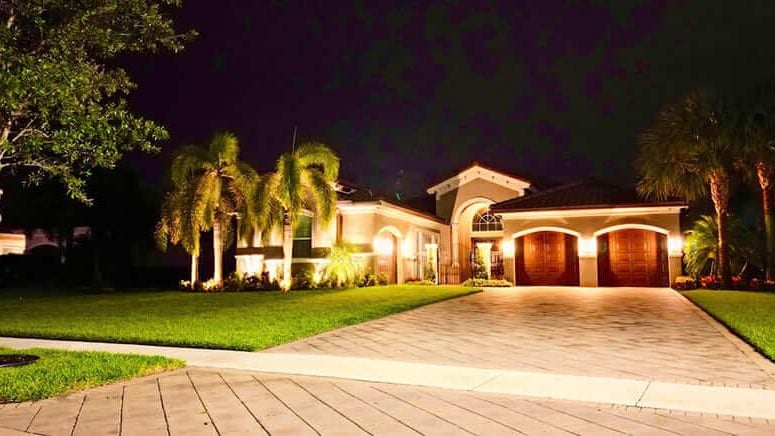
Most Fort Lauderdale homeowners spend between $2,500 and $6,000 on a professionally installed landscape lighting system, and the number lands wherever it lands based on three things: how many fixtures you need, what those fixtures are made of, and how hard they are to wire. A front-yard system that lights a facade, a driveway and a few palms is the common starting point. A whole-property design that wraps the pool deck, the lanai and the back garden runs higher, often past $8,000.
That spread is wide enough to be frustrating, so this guide breaks the number apart. Here is what you are actually paying for, what South Florida does to the math that national price guides miss, and how to read a quote well enough to tell a real system from a kit that will not survive two summers.
Typical project costs by size
Landscape lighting is priced per fixture, then adjusted for the transformer, the wire run and the labor to get power where it needs to go. Here is how that adds up at the project level in Broward County.
| Project scope | Fixtures | Typical installed cost |
|---|---|---|
| Entry and facade accent | 4 to 6 | $1,400 to $2,800 |
| Full front yard with driveway | 8 to 12 | $2,500 to $5,500 |
| Front and back, standard lot | 15 to 20 | $5,000 to $9,500 |
| Whole property with pool deck and moonlighting | 25 to 40+ | $9,000 to $20,000+ |
These ranges reflect real project costs in the Fort Lauderdale and Broward County market in 2026. Prices vary based on the specific factors we cover below.
They assume professional-grade brass or copper fixtures, integrated LED, a properly sized transformer and buried low-voltage cable with waterproof connections. Big-box aluminum and plastic kits come in far cheaper, and the section on materials below explains why that discount is borrowed rather than saved.
Be careful with a quote that lands well below these ranges. The usual reason is that something has been left out of it: the transformer, the permit where one is required, trenching under existing hardscape, or the waterproof connectors that decide whether the system survives its third summer.
Lighting is also one of the easiest pieces to phase alongside other outdoor work, which is worth knowing if you are budgeting a larger project. We broke down the numbers the same way for pools in how much a pool costs in Fort Lauderdale.
What each fixture costs
Per-fixture pricing is the honest way to compare two bids. If one quote shows a lump sum and the other shows fixture counts and types, you can only compare the second one to anything.
| Fixture type | What it does | Installed cost each |
|---|---|---|
| Path and area light | Lights walkways, garden beds, driveway edges | $200 to $450 |
| Up-light or spotlight | Grazes palms, trees, architecture, feature walls | $225 to $450 |
| Well light, drive-over rated | Flush uplighting in paving and turf | $300 to $500 |
| Down-light or moonlighting | Mounted high in trees or eaves for soft overhead wash | $350 to $600 |
| Bollard path light | Taller post-style lighting for driveways and long walks | $250 to $500 |
| Underwater and water feature light | Pools, spas, fountains and water walls | $300 to $650 |
| Hardscape and step light | Integrated into walls, risers, seating, coping | $200 to $400 |
| Transformer | Converts 120V to 12V and powers the system | $400 to $700 |
| Smart or app-based control | Zones, scenes, scheduling, dimming | $100 to $300 |
Down-lights cost the most to install because they involve ladder work and mounting into a tree canopy or a soffit, not just a stake in a planting bed. Well lights cost more because they sit in a sealed housing that has to shed water and take weight. Path lights are the cheapest to trench for, which is why they tend to anchor a first-phase design.
Why South Florida changes the price
Outdoor work in Broward County runs higher than it does in inland Florida markets, and landscape lighting is no exception. Part of that is labor and permitting. Most of it is corrosion.
Salt air off the Intracoastal and the beach communities attacks aluminum fixtures and the sockets inside them. Add year-round humidity, afternoon storms, irrigation overspray and a water table that puts buried connections in standing water several times a year, and the cheap fixture does not fail gracefully. It pits, the socket greens over, the lens fogs, and the light goes out one by one across the yard. In the coastal Broward properties we have worked on, aluminum kit fixtures typically start failing by the second summer.
How hard this hits you depends on where you are. A property in Hallandale Beach, Dania Beach or anywhere within a few blocks of the Intracoastal sits at the harsh end of that range. Move inland to Parkland, Weston or the western edge of Coral Springs and corrosion slows considerably, which changes what materials are worth paying for. It is one of the first things worth establishing before anyone quotes you.
Brass, copper and bronze cost more per fixture and they are the materials that actually reach ten years and beyond in this climate. They develop a patina instead of corroding through. Pair them with gel-filled waterproof connectors rather than twist caps, and the system survives the trench flooding that kills ordinary installs.
So the real comparison between a budget fixture and a professional one is not the price on the box. It is one fixture that gets replaced several times in a decade against one fixture that does not.
Pool and water areas add compliance cost
Lighting near a pool, spa or water feature is not just another fixture location. Work in that zone has bonding and clearance requirements, which means a licensed installer and a design that accounts for them. Expect that portion of a project to carry higher labor than an equivalent fixture count in a planting bed.
What moves your quote up or down
Distance from the power source
Every run of low-voltage cable has to get from the transformer to the fixture, and voltage drops over distance. A long back-yard run may need heavier gauge wire or a second transformer. Trenching under existing paver patios and walkways costs more than trenching through open turf, which is the single best argument for planning lighting at the same time as hardscape rather than after it.
Fixture count versus fixture placement
Twelve well-placed fixtures outperform twenty badly placed ones, and they cost less. Good design is additive here: cross-lighting a single specimen palm from two angles reads better at night than ringing it with six lights. This is where seeing the plan before anyone digs matters, and it is why 3D landscape design renders are worth asking for. You can judge the nighttime effect, the fixture count and the budget on screen instead of discovering it after installation.
Retrofit versus new install
Replacing failed fixtures on an existing system is cheaper per light if the cable and transformer are sound. If the old system used undersized wire or failing connections, a retrofit turns into a rebuild, and a reputable contractor will tell you that before quoting rather than after.
Controls and zoning
A single timer is the baseline. Zoning the property so the pool deck, the facade and the garden run on separate scenes costs a little more in control hardware and wiring, and it is the upgrade homeowners mention most after the fact.
What it costs to run
This is the part that surprises people. An LED low-voltage system is cheap to operate. A ten-fixture system draws about what one old halogen bulb used to, and most homeowners see a few dollars a month on the power bill. Quality LED boards hold up for 15 to 20 years.
Maintenance, not electricity, is the real ongoing line item. In South Florida that means occasional re-aiming as plants grow in, cleaning lenses, and checking connections. On a well-built system with sealed connectors, that is a light annual inspection. On a kit system it is a recurring replacement bill.
How to read a landscape lighting quote
Ask for four things in writing, and most of the ambiguity disappears:
- Fixture count by type and material. Brass, copper or aluminum, stated plainly. “LED outdoor lighting” tells you nothing about what will survive.
- Transformer size and location. Sized with headroom, so adding a zone later does not mean a second transformer.
- Wire gauge and connection method. Gel-filled waterproof connectors, not twist caps.
- The warranty, split into two parts. Manufacturer coverage on the fixtures and the contractor’s coverage on the workmanship. Those are different promises, and the second one is the one that fails first in a wet climate.
At TotalScape Design, the workmanship side carries a lifetime guarantee, and the design side comes with a commitment that your initial design is delivered within seven days or it is free. With more than 40 years of outdoor living work in Broward County and crews who are employees rather than subcontractors, the quote you approve is the one that gets installed.
Frequently asked questions
Is landscape lighting worth the cost in Fort Lauderdale?
It is the lowest-cost improvement that changes how a property looks and functions after dark, which in South Florida is most of the time people are actually outside. It also extends the usable hours of a pool deck, patio or outdoor kitchen you have already paid for, and it meaningfully improves safety on steps, driveways and walkways.
Can I install landscape lighting myself and save money?
You can, and plenty of homeowners do. The savings are real up front and tend to erode within a few years as coastal corrosion takes the fixtures and the connections. If you go the DIY route, spend the money on brass fixtures and waterproof connectors rather than on fixture count. Anything in a pool or spa zone should go to a licensed installer regardless.
How long does a landscape lighting installation take?
Most residential projects are completed within two to three days once the design is settled and materials are on hand. Larger properties with moonlighting, long cable runs or trenching under existing hardscape take longer. Design and permitting timelines sit in front of that and vary by municipality.
What is the difference between low-voltage and line-voltage outdoor lighting?
Low-voltage systems run at 12V through a transformer, which makes them safer around planting beds and pool areas, easier to adjust and the standard for residential landscape lighting. Line-voltage runs at 120V, needs conduit and a licensed electrician, and generally appears only in specific commercial or high-output applications.
How many fixtures does an average Fort Lauderdale yard need?
Front yards usually land between 8 and 12 fixtures to cover the facade, the entry, the driveway edge and two or three specimen plants. A full property with a pool deck and rear garden commonly runs 20 to 35. The right answer comes from the design, not from a per-square-foot rule.
Get a Real Number for Your Property
Price ranges are useful for setting expectations and useless for making a decision. Every property is different, and the only way to get an accurate cost for yours in Fort Lauderdale is a site consultation.
TotalScape Design handles landscape lighting design and installation in Fort Lauderdale and across Broward and Palm Beach County, including Pompano Beach, Dania Beach, Davie, Deerfield Beach, Pembroke Pines, Hallandale Beach, Sunrise, Weston, Coral Springs and Parkland. You see the plan in 3D before anything is installed, and the workmanship is guaranteed for life.
Call (561) 269-4959 or email admin@totalscapedesign.com to start your lighting design.
Installed costs shown here are market ranges for the Fort Lauderdale and Broward County area in 2026, not a TotalScape Design price list. Design and permitting timelines sit in front of installation and vary by municipality; confirm permit requirements for your address before finalizing a lighting plan.