
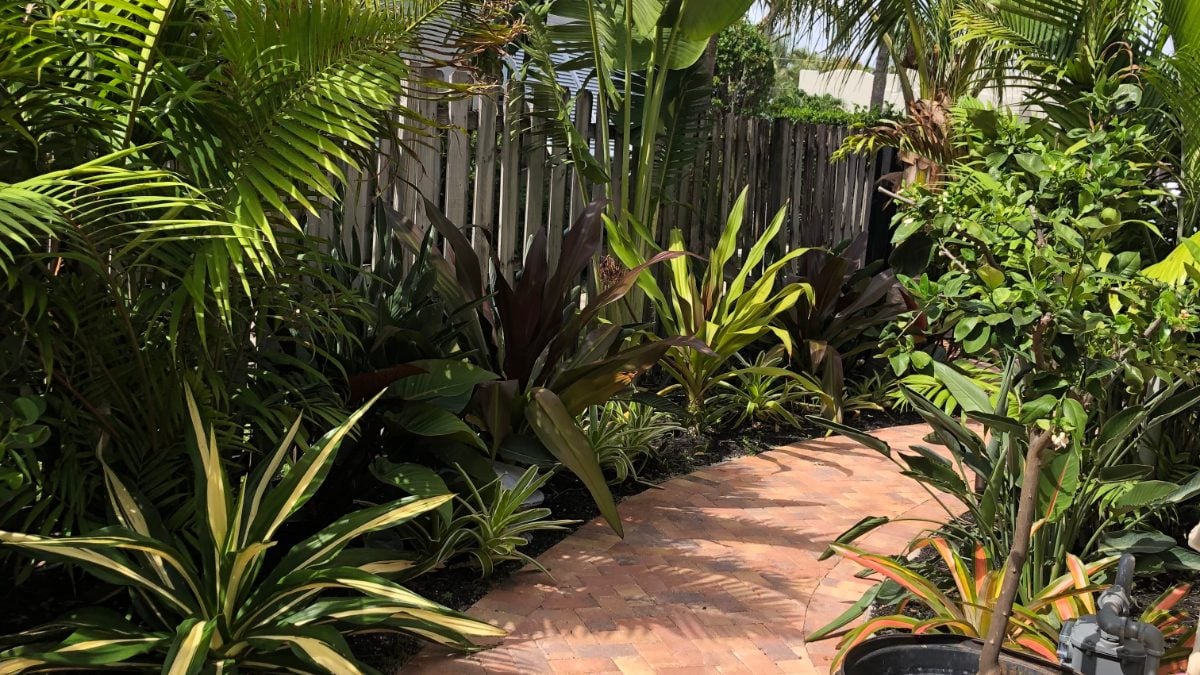
Most landscape disappointments in Broward County are not planting mistakes. They are selection mistakes: a plant that would thrive in Orlando or Tampa put into sandy, alkaline, salt-touched soil that it was never built for. Get the selection right and a South Florida landscape can look full and intentional within a single season. Get it wrong and you spend years fighting yellow leaves, thin hedges and replacements.
This guide covers the plants that actually perform in Fort Lauderdale, Pompano Beach, Hallandale Beach and the rest of Broward County, organized by the conditions in your yard rather than by what happens to be in stock at the nursery.
What Makes South Florida Planting Different
Broward County sits in USDA hardiness zone 10b, with the immediate coastline edging into 11a. That means frost is essentially off the table. But hardiness zones only describe cold, and cold is the one thing your plants will never have to survive here. Four other conditions do the real selecting:
Alkaline, rocky soil. Much of eastern Broward sits on limestone with a thin sandy cap. Soil pH commonly runs between 7.5 and 8.2. At that pH, iron and manganese lock up chemically and become unavailable to roots, which is why so many local hibiscus, ixora and gardenia turn pale yellow between green veins. The plant is not underwatered or underfed. It simply cannot absorb what is already in the ground.
Two seasons, not four. Roughly 70% of the region’s annual rainfall arrives between May and October. From November through April, a landscape can go weeks without meaningful rain while irrigation is typically restricted to a limited number of days per week under South Florida Water Management District rules. A plant that needs consistent moisture year-round is a plant that will look rough for half of every year.
Salt. Within about a quarter mile of the ocean or the Intracoastal, wind-carried salt spray burns the leaf margins of intolerant species. Salt also accumulates in soil near seawalls.
Wind. Hurricane season runs June through November. Species differ enormously in how they handle sustained wind, and the difference is usually structural, not a matter of size.
The five conditions to match before you choose anything
| Condition | What to check in your yard | Why it decides the plant list |
|---|---|---|
| Soil pH | A $15 test kit, or look for yellowing between green leaf veins on existing shrubs | Above 7.5, acid-loving species will stay chlorotic no matter how you feed them |
| Sun hours | Count actual direct sun at 10am, 1pm and 4pm | “Full sun” in South Florida is far more intense than the same label up north |
| Salt exposure | Distance to open water and whether prevailing wind reaches the bed | Determines whether you need high, moderate or no salt tolerance |
| Drainage | Fill a 12-inch hole with water; note how long it takes to drain | Sandy fill drains in minutes; low spots over marl can hold water for hours |
| Irrigation access | Whether the bed is on a zone, and which zone | Mixing thirsty and drought-tolerant plants on one zone guarantees one group suffers |
South Florida Native Plants Worth Building Around
Natives are not automatically better looking, but they are already adapted to alkaline soil, seasonal drought and wind, which makes them dramatically lower maintenance once established. These are the ones that do the most design work:
| Plant | Role | Sun | Salt tolerance | Why it earns a spot |
|---|---|---|---|---|
| Coontie (Zamia integrifolia) | Low groundcover / mass planting | Sun to part shade | Moderate | Nearly indestructible, evergreen, and the only native host plant for the atala butterfly |
| Cocoplum (Chrysobalanus icaco) | Hedge / screen | Full sun | High | Dense, clean-edged hedge with minimal litter. The reliable alternative to ficus |
| Firebush (Hamelia patens) | Flowering shrub | Full sun | Moderate | Orange-red tubular blooms nearly year-round; pulls in hummingbirds and butterflies |
| Simpson’s stopper (Myrcianthes fragrans) | Small tree / tall hedge | Sun to part shade | Moderate | Fragrant white flowers, peeling cinnamon bark, exceptionally tidy habit |
| Saw palmetto (Serenoa repens) | Architectural mass | Full sun | High | The silver form reads as a designed element rather than scrub; essentially zero maintenance |
| Gumbo limbo (Bursera simaruba) | Shade tree | Full sun | High | Among the most wind-resistant trees in the region; sculptural copper bark |
| Sabal palm (Sabal palmetto) | Vertical accent | Full sun | High | Florida’s state tree and the most storm-reliable palm you can plant |
| Muhly grass (Muhlenbergia capillaris) | Ornamental grass | Full sun | Moderate | Pink autumn plumes that give a South Florida bed genuine seasonal change |
Drought-Tolerant Plants for Full Sun
For beds that face west, sit against a driveway, or fall outside irrigation coverage, you want species that treat the November to April dry season as normal rather than as stress. Reliable performers include:
- Bahama cassia: yellow blooms in fall, the larval host for cloudless sulphur butterflies, and completely at ease in dry sand
- Beach sunflower: a spreading groundcover that covers hot, exposed ground faster than almost anything else
- Blanket flower: red-and-yellow daisies that reseed themselves and shrug off both drought and salt
- Agave and dwarf yucca: sculptural, evergreen, and effectively zero-water once rooted (site them away from walkways; the leaf tips are sharp)
- Silver buttonwood: silvery foliage that holds its color through the dry season and takes hard shearing as a hedge
- Dwarf fakahatchee grass: a fine-textured green mass that handles both standing water in August and drought in March
A caution worth repeating: drought tolerance is a description of an established plant. Nearly everything on this list needs consistent water for the first 8 to 12 weeks while roots move out of the nursery ball into native soil. Most “drought-tolerant” failures in Broward are actually establishment failures.
Salt-Tolerant Plants for Coastal Yards
East of Federal Highway, and anywhere along the Intracoastal in Fort Lauderdale or Hallandale Beach, salt tolerance stops being optional. The highest-tolerance workhorses are sea grape, green and silver buttonwood, cocoplum, saw palmetto, sabal palm and spider lily. For color in a salt-exposed bed, blanket flower, beach sunflower and railroad vine all hold up.
What consistently fails within sight of open water: azalea, gardenia, most Japanese boxwood, and anything sold with a “protect from wind” tag. If a plant needs shelter in its native range, it will need shelter here too.
Plants for Pool Decks, Patios and Paver Edges
Planting near hardscape is a different problem from planting in an open bed, and it is where most expensive mistakes happen. Two failure modes dominate: litter and roots.
Litter means anything that drops into water or stains stone: fruit, heavy flower drop, constant leaf shed. Roots means species aggressive enough to lift pavers or crack a pool shell over five to ten years. Ficus, black olive, queen palm and royal poinciana are all beautiful trees that do not belong within fifteen feet of a deck.
Better choices around water and stone: small-leaf clusia for a clean privacy hedge, cocoplum where you want native and salt-tolerant, bromeliads for color in the shade of a pergola, coontie along a paver edge, and Adonidia (Christmas) palm where you need vertical interest without an invasive root system. Muhly grass planted in a run along a deck edge softens the line without dropping anything into the water.
If your paver, coping or retaining wall work is being planned at the same time as the planting, plan them together rather than in sequence: root barriers, bed depth and drainage are far cheaper to build in than to retrofit. Our hardscaping team in Fort Lauderdale sets bed elevations and root barriers during construction for exactly this reason.
Plants to Avoid in South Florida
| Avoid | Why | Plant instead |
|---|---|---|
| Brazilian pepper, Australian pine, melaleuca, carrotwood, earleaf acacia | Listed invasive species in Florida; several are illegal to plant and actively displace native habitat | Gumbo limbo, live oak, Simpson’s stopper |
| Ficus benjamina hedges | Aggressive roots that lift hardscape, plus recurring whitefly pressure | Cocoplum or small-leaf clusia |
| Queen palm | Poor wind performance, heavy fruit drop, chronic nutrient deficiency in alkaline soil | Sabal palm or Adonidia palm |
| Gardenia, azalea, most acid-loving shrubs | Permanent chlorosis at local soil pH: they cannot take up iron | Simpson’s stopper, firebush, plumbago |
| Cool-season annuals in summer | Collapse in wet-season heat and humidity within weeks | Blue daze, pentas, coleus, blue porterweed |
| Mexican petunia (Ruellia simplex) | Still sold widely, but listed as a Category I invasive in Florida: it escapes cultivation and displaces native wetland plants | Blue porterweed, tropical sage, melampodium |
Grouping Plants So the Design Actually Holds Up
A good plant list still produces a mediocre landscape if the plants are scattered. Three principles separate a designed yard from a collection:
Hydrozone. Group plants by water need, not by appearance. Thirsty plants belong on one irrigation zone, drought-tolerant plants on another. Mixing them means you either overwater one group into root rot or underwater the other into decline, and in a region with two-day irrigation limits, that trade-off is unavoidable if the zones are mixed.
Layer in threes. A groundcover layer, a shrub layer and a canopy or accent layer. Coontie under firebush under a gumbo limbo reads as intentional. The same three plants spaced evenly apart across a bed reads as a nursery display.
Plant for mature size. The single most common regret in South Florida landscapes is spacing for the pot rather than for year five. Cocoplum installed at three feet on center looks sparse the day it goes in and becomes an impenetrable wall that needs constant shearing by year three.
This is exactly where seeing the plan beforehand changes decisions. Our 3D landscape design service renders your yard photorealistically at maturity, so you can judge whether that hedge line, that palm placement and that bed depth are what you actually want before a single plant is ordered.
When to Plant in Broward County
| Window | Best for | Notes |
|---|---|---|
| October to December | Trees, palms, hedges, most shrubs | The strongest planting window. Soil is still warm from the wet season, heat stress has eased, and roots get months to establish before the spring dry-down |
| January to February | Hardy shrubs, groundcovers, grasses | Workable, but plan on supplemental hand-watering; this is the driest stretch of the year |
| March to May | Container color, small perennials | The hardest window. Heat is climbing and the rains have not started. Avoid large installations if you can |
| June to September | Palms, tropicals, turf | Natural rainfall does the watering, but hurricane season argues against installing large specimen trees that have not yet rooted in |
If you are planning a full renovation rather than filling in a bed, the October window is worth building the schedule around. Our landscape design and installation team sequences grading, irrigation and planting so that everything goes in the ground during that window rather than stretching across the dry season.
Frequently Asked Questions
What are the best low-maintenance plants for a South Florida yard?
Coontie, cocoplum, saw palmetto, sabal palm and muhly grass are the five that ask for the least once established: no acid-forming fertilizer, no frost protection and minimal irrigation after the first three months. Coontie in particular can go years with essentially no attention. The trade-off is that low-maintenance species tend to be slower growing, so plant them at a larger size if you want immediate presence.
Why do my hibiscus and ixora have yellow leaves with green veins?
That pattern is iron or manganese chlorosis, and in Broward County it is almost always a soil pH problem rather than a fertilizer problem. At a pH above 7.5, those nutrients are chemically unavailable no matter how much you apply. A chelated iron drench gives short-term improvement, but the durable fix is either acidifying that specific bed or replacing the plant with a species suited to alkaline soil.
How close to a pool can I plant?
The workable rule is that anything within about eight feet of the coping should have low litter and a non-aggressive root system: clusia, cocoplum, coontie, bromeliads and ornamental grasses all qualify. Trees with substantial root systems should sit fifteen feet or more from the pool shell and deck, and should be installed with a root barrier if that distance is not available.
Do native plants really need less water than tropical ornamentals?
After establishment, yes: substantially less, because they evolved with this exact rainfall pattern. During establishment, no. A newly planted native needs the same consistent moisture as anything else for the first eight to twelve weeks while roots move out of the nursery soil. Most native plant failures in South Florida happen in that window, not later.
Which plants hold up best in a hurricane?
Among trees, sabal palm, gumbo limbo and live oak consistently perform best; among palms, sabal and Adonidia. Shrubs and groundcovers rarely fail structurally: the risk is salt burn from storm surge and wind-driven spray, which salt-tolerant species like cocoplum, sea grape and buttonwood recover from within a season. What to avoid near structures: queen palm and any shallow-rooted tree planted in shallow fill over limestone.
Planning a South Florida Landscape?
Plant selection is the last step of a good design, not the first. Before choosing a single species, TotalScape Design assesses your soil, sun, salt exposure and drainage, then shows you the finished yard in photorealistic 3D before anything is installed. We serve Fort Lauderdale, Pompano Beach, Hallandale Beach and all of Broward County.
Growing conditions vary block by block in Broward County, particularly near the coast. Plant hardiness and salt-tolerance ratings referenced here follow UF/IFAS Florida-Friendly Landscaping guidance; confirm current irrigation restrictions with Broward County and the South Florida Water Management District before finalizing an irrigation plan.